Wednesday, August 28, 2013

Our Lady of the New Millennium - Macarena


OUR LADY OF HOPE MACARENA (NUESTRA SENORA DE LA ESPERANZA MACARENA) is the most revered in Andalucia.  Macarena was derived from the patrician Roman male name Macarius.  Others say the word was from the Arabic city-wall gate Bab-al-Makrim which is still standing today. 


The wooden statue of Mary was designed by Luisa Roldan in 1656 to 1703.  She created the grieving yet hoping Mother of Christ.  In the early morning of Good Friday, Sevillans hold a long procession of Our Lady of Macarena with many white flowers and candles. There are tears on her face because She lost her Son in the hope and salvation of humanity. 


Her home is at the Basilica of Macarena in Sevilla, the capital city of Andalucia in Spain.  Andalucia was occupied by the Moors for 800 years - many different cultures - the Romans, Arabs, Jews and gypsies live there.  The church was founded in 1595 but caught fire in 1936, at the beginning of Spanish Civil War.  She is the Protector of Bullfighters.  Before they go to the bullring, they would pray to her for protection.  


+++++++++++++++++++++++++++++++++++


[Recycled Web Page]


+++++++++++++++++++++++++++++++++++


March 14, 2012
A spiritual visit to OUR LADY OF THE NEW MILLENNIUM -  ST. JOHN THE EVANGELIST PARISH, in St. John, Indiana:
11301 West 93rd Avenue, St. John, IN 46373
(219) 365-5678
Sunday Mass: 7:30 AM; 9:30 AM; 11:30 AM 


It's also the site of The Shrine of Christ's Passion - "Where lives are changed one soul at a time."
Journey through the Passion of Christ: An interactive half mile winding pathway that begins with the Last Supper and Garden of Gethsemane.
  • Sit with Our Lord at the Last Supper.
  • Pray with Him in the Garden of Gethsemane
  • Stand beside him as Pilate washes his hands condemning Jesus to his brutalizing journey and death.
  • Walk along side Him on the rocky road to Calvary.
  • Hold His hand as He meets His Mother.
  • Rejoice with the Apostles as you enter the empty tomb.


    The 40 Life size bronze statues are an exquisite work of art.  Each setting has a listening station where by pushing a button you hear a description of the scene.  As you exit the tomb and continue down the path, you will find Jesus meeting Mary Magdalene and then experience His glorious Ascension to heaven.


    Published  3/18/12  ust1611 multiply
    Web Page: Our Lady of the New Millenneum

    Wednesday, August 14, 2013

    Faces Of Mary Our Lady of Akita


    OUR LADY OF AKITA - THE WEEPING STATUE OF MOTHER MARY.  From 1949 to July 2012, there were 14 unverified and proven hoaxes of reported weeping of tears or blood of the Virgin Mary.

    On July 6, 1973 Sister Agnes Katsuko Sasagawa reported of the weeping Mother Mary in Yuzawadai, Akita prefecture (state), Japan.  Sister Agnes was suffering for a poorly performed appendix operation and was not feeling well for decades.  She improved after drinking water from Lourdes.


    In an apparition, the Virgin Mary told her, "Pray very much the prayers of the Rosary  I alone am able still to save you from calamities."  What was most unusual was the crying statue of the Virgin Mary was broadcast on national television in Japan.


    In June,1988 the Bishop of Akita brought his episcopal letter to Cardinal Joseph Ratzinger who later became Pope Benedict XVI.  Only one, the Weeping Our Lady of Akita, was declared worthy of belief by the Vatican in the same year. 


    Priests at the Vatican putting the Statue of Our Lady of Akita on the coffin of Pope John Paul II


    Eucharistic Prayer of Our Lady of Akita

    Most Sacred Heart of Jesus, truly present in the Holy Eucharist, I consecrate my body and my soul to be entirely one with Your Heart being sacrificed at every instant on all the altars of the world and giving praise to the Father, pleading for the coming of His Kingdom.  Please receive this humble offering of myself.  Use me as you will for the glory of the Father and the salvation of souls Most Holy Mother of God, never let me be separated from Your Divine Son.  Please defend and protect me as your Special Child.
    Amen.


    UNVERIFIED OR HOAX OF A WEEPING STATUE OF MARY
    On July 16, 2012 a statue of Mother Mary was reported to be weeping blood at the Carmelite of Mary Immaculate (CMI) at Bhavan, Marianagar, Ghaziabad - a satellite town of New Delhi.  The blood was tested for typing at nearby St. Jospeh Hospital and came back as Type B+ve.  This blood type is common to 40% of people in Northern India.  This is highly suspicious and undoubtedly a hoax.  The Virgin Mary was a Jew - the blood type of the Jewish people I yet have to check.

    Video  http://youtu.be/KYtUuN9ekJo  


    Susmaryosep! Halatang hindi tutuo.


    ++++++++++++++++++++++


    To Vicky, Lydia & Devotees of the Blessed Mother Mary,
    I'm doing something beautiful for God today, that is, sharing with you this fascinating video
    http://www.FacesOfMary.net 

    http://youtu.be/h1Eebt_lgXM

    which is already viewed all over in Russia, Australia and even Saudi Arabia.  Did you know that Mary is the only woman mentioned in the Quran (Koran)?  Yes!  I liked this particular video because each Mary is gently, not fast, morphs into the next.  I recognized Christendom's sacred art, from the sixth Century to 1900.  I see Leonardo, Raphael, Bellini and other famous paintings that I saw when I visited different awesome churches of Europe.  All built for the glory of God.  The background chant of the "Magnificat" is sung by the seminary choir of the Institute of Christ the King Priest, of S. Woodlawn, Chicago, http://www.institute-christ-king.org  and its Sister Adorers of the Royal Heart of Jesus.


    Published  9/12/10  ust1611 multiply
    Web Page: Faces of Mary

    Saturday, July 27, 2013

    A Miraculous Lady In Batangas and Pangasinan


    Oh, my! The year 1611 is not only of religious significant to UST but also to devotees of Our Lady of Caysasay.


    From: lt
    Subject: FW: A Miraculous Lady In Batangas
    Date: Sat, 18 Feb 2012 23:18:55 -0600

    The miraculous Lady in Batangas, also known as Our Lady of Caysasay is not only for the BatangueƱos.  
    The story of how she sprang from out of the waters way back in1603 is something for us all to cherish. 
    Many Filipinos, while aware of local Marian sites as in Manaoag and Antipolo, are not aware of
    Our Lady's manifestations in Labac, Taal. Taal, after all, is more known for its small volcano.  
    This scenic town has a lot of tourism potential and was listed in the World Heritage list since it is
    of the most culturally-preserved sites of the Spanish colonial era. The charming story of how the
    image of Our Ladyof Caysaysay was found and the numerous apparitions and miracles the
    Holy Image performed is best captured in the article below...      


    A Miraculous Lady In Batangas

                                         By Ma. Glaiza Lee, February 16, 2012


    The fluvial parade along Pansipit River.(Photo by PINGGOT ZULUETA)


    The fluvial parade along Pansipit River


    MANILA, Philippines — For fisherman Juan Maningkad, that fateful day in 1603 was just another opportunity to cast his net into the Pansipit River in Taal, Batangas and catch whatever he could for his family’s consumption. Little did he imagine that his innocent daily routine of fishing early in the morning would change not only his life, but also the whole town’s.


    As he began to pull his net out of the river, Juan felt it was a little heavier than usual. He thought to himself that perhaps it was his lucky day because he had enough catch which he could sell and make some money for the family.


    When the net reached the surface, he was astounded when he saw a 12-inch tall image of the Blessed Virgin Mary. It was so beautiful, with a heavenly halo emanating from the very heart of the image. Although it was soaked in the water, the image retained a heavenly luster, with its face clean and devoid of any dirt.


    No one knew how the image got into the river. Legend has it that the image was thrown into the ocean by one of the Spaniards to pacify a raging storm that caught them while on an expedition. Some said it was perhaps dropped by someone exploring the river; while others believed that the image came from China, brought by the Chinese merchants trading on Philippine shores.


    Quite a pious man, Juan humbly fell down on his knees, prayed to God and venerated the image. Then, he brought the image home.


    Like wildfire, the news of the image’s discovery spread throughout the whole village and people came to pay homage to it. And soon enough, the town authorities and the Vicar who represented the King of Spain learned about it and went to Juan’s house to verify the story.


    When the story was confirmed to be true, the town officials thought that it was better to transfer the image to a safe place near the Taal church. They decided to move it to the house of DoƱa Maria Espiritu, the widow of the town’s judge, who ordered the creation of a special urn where the image could be placed for safekeeping.


    But then, strange things began to happen.


    For the next consecutive nights, DoƱa Maria would find that the urn’s lid had been removed and the image wasn’t there. But in the morning, after the sun had risen, she would find the missing image inside the urn again.


    When she first noticed this strange incident, DoƱa Maria would order all her servants to look for the missing image. But alas, even if they had searched every nook and cranny of the house, even as a far as the garden, they couldn’t find the image. And when they were finally too exhausted and had already given up, DoƱa Maria would find it back in the urn as the dawn was breaking on the horizon.


    Worried and perhaps a little disturbed, DoƱa Maria reported the matter to the parish priest who decided to investigate the mysterious incident. He asked some volunteers to keep vigil beside the urn. The volunteers kept their eyes glued to the urn, fighting to stop their eyes from blinking, so as to not miss anything.


    When the clock struck midnight, the volunteers couldn’t believe their eyes – the urn opened by itself and out came the beautiful image of the Blessed Virgin Mary. They were too astounded that they couldn’t move their feet even if they wanted to follow the image. As dawn arrived, they saw the image returning to the urn.


    The people reported the incident to the priest, and he ordered the villagers to follow the image next time it left. And that was exactly what they did.


    Holding lighted candles, the villagers followed the image. It led them to Caysasay, the town where the fisherman originally found the image. The town was named after the kingfisher, which the locals called casay-casay. But the Spaniards mispronounced it as caysasay; hence, the name of the town.


    The priest decided to bring the image to the church for safekeeping. But the same incident happened. And soon, the image completely disappeared. No matter how far and extensively they searched, they couldn’t find the image anymore. It seemed like it had disappeared forever.


    Several years later, in 1611, while Catalina Talain and her companion were gathering firewood and fetching water near the place where Juan Maningkad found the image, they noticed a bright reflection amidst the shadows of some trees’ branches. The two women went near it. Catalina saw a small object, radiating astounding brilliance from a hollow in the rocky part of the town. Bewildered, she rushed to her companion, and they both fled in fear to the town of Taal.


    Based on the study of historian Jose M. Cruz, S.J., the church officials later interrogated Catalina and her companion, but the girls told them that they could not clearly identify what Catalina really saw.


    Later that year, on the same spot where Catalina saw the brilliant object, Maria Bagohin and Maria Talain saw the same apparition. They saw a blurred reflection in the spring where the townsfolk fetched water. As they got nearer and nearer, the reflection became clearer. It was that of the image which had been lost several years ago. When they looked up, the two saw the image on the branch of a tall sampaguita bush.


    Two candles were illuminating it, like a spotlight on a stage, while the kingfishers seemed like guards standing over the image. The two women hurried back to town and reported it to the parish priest, who concluded that the Blessed Virgin Mary really wanted to stay in Caysasay.


    So, they decided to build a church on the very sport where the image was originally found. The image later became known as the Our Lady of Caysasay.


    But the mysteries and miracles didn’t stop there. When the people learned about the story of the image of the Lady, they would flock to the hill. Juana Tangui, a native servant girl of one of the wealthiest and prominent people in that town, heard about the news and decided to see for herself.


    The native servant was suffering from a burning sensation in her eyes. She had already used several remedies she could think of, but still she was not cured. For the longest time, her ailment had been causing her discomfort and pain.


    Armed with her strong faith, Juana, accompanied by her master’s daughter, went to the hill and bathed in the stream which people believed to be miraculous and could heal any ailment.


    While bathing, Juana noticed a shadow by her side and felt as if someone was holding and turning her around. When she turned, Juana saw a brilliant light, but she dared not go to investigate. Later when she told the villagers what she saw, they urged her to visit the area again and verify the vision.


    Following their advice, Juana and her master’s daughter went to the area. She left the little girl in a certain place and moved forward. There, she saw the image of the Lady, “almost two palm measurements in height, dressed in white, with a crown on her head and a cross on her forehead.” (Reported by Fr. Pedro Galende, O.S.A, in his book “Angels in Stone: Augustinian Churches in the Philippines.”)


    When Juana moved closer, the Lady spoke to her, thanking her for remembering and ordering her to wear the belt of the Confradia on her next visit. She didn’t tell anyone about it, until she met Fr. Juan Bautista Montoya of the Taal Convent who immediately gave her the belt. Juana immediately returned to the place, knelt before the Virgin Mary and talked to her.


    She asked the Lady how she could prove to the people that the Lady had really spoken to her. The Lady told her that the rosaries that Juana brought with her would be the proof and the Blessed Mary proceeded to touch the religious items. When Juana distributed the rosaries, the people could distinguish a fragrance so perfect and extraordinary emanating from them.


    This was believed to be the first recorded Marian apparition in the country. In 1954, the Lady was canonically crowned and given the title “Queen of the Archdiocese of Lipa.”


    The town of Taal celebrates the feast of the Lady every year during the month of December. The feast would begin with a nine-day novena that would usually end on December 7. The next day, December 8, a mass would be held in the Our Lady of Caysasay Church in Barrio Labac, after which the image would be paraded through the barrios of Labac, Tatlong Maria and Seiran.


    When the image arrives at the Pansipit River area, it would be transferred to a float, to be carried by the devotees on the river. Along the river banks, people would gather to witness the fluvial parade.


    When the parade reaches Nagpuloc, the image would be again transferred to a carosa and the parade would continue towards the Basilica of Taal. Devotees would often follow the carosa, while praying the rosary. The procession ends in the basilica, with a luwa or declamation in honor of the Virgin Mary. 


    -->
    Published 2/21/12  ust1611 multiply
    Web Page: A Miraculous Lady in Batangas


    +++++++++++++++++++++++++++

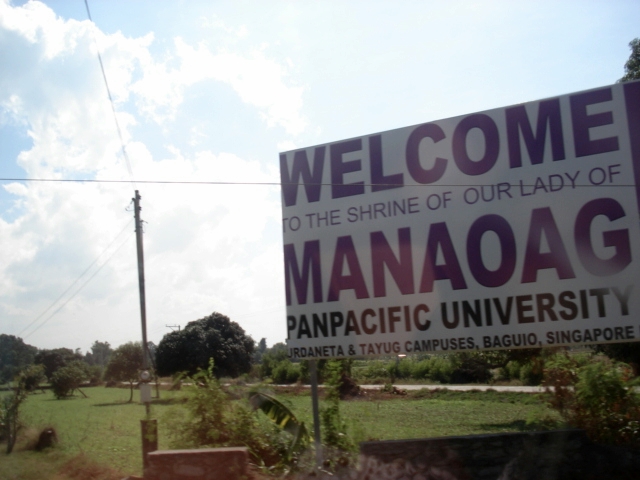
    OUR LADY OF MANAOAG VISITING VICKI'S HOME FOR A WEEK

    The Virgin Mary is the Queen of Heaven and Earth.  Wherever she goes, she takes the name of the place she visits.  The shrine of the miraculous Our Lady of Manaoag is in the town of Manaoag, Pangasinan.  Many pilgrims visit her everyday to pray.

    Our Lady of Manaoag Prayer

    Virgin Mother of God, Queen of the Most Holy Rosary, those who has chosen to raise thy throne of mercy in Manaoag, to be the beloved Protectress and Patron of the Province of Pangasinan, and there from to bestow thy grace on us, thy children, banished in this valley of tears, look down with thine eyes of mercy upon me, who am beset with so many dangers of body and soul.  Despite not my petition, O dearest Mother, but intercede for me before thy Divine Son now and at the hour of my death.

    Virgin of Manaoag, pray for us.

    Our Lady's visit is over - She's visiting another home


    Reloaded 7/27/13  ust1611 blogspot


    +++++++++++++++++++++++++++++++


    VISIT TO THE SHRINE OF OUR LADY OF MANAOAG
    FEBRUARY 17, 2011


    Sunday, July 21, 2013

    Friends on Summer Trip to New England

    FRIENDS...Are Like Flowers
    Text by Vicki [UST MedTech]
    YouTube Video: DoubtingThomasian


    ~~~~~~~~~~~~~~~~~~~~~~~~~~~~~~~~~~~~~~~~~

    JULY 21 - AUGUST 4, 2013  SUMMER ROAD TRIP TO NEW YORK, NEW ENGLAND AND CANADA BY MEDTECHS MADONNA, SUSAN, CARME, SOFIE, NERIE, JOSIE, HEDY AND LILY.

    Madonna wrote she did not see her batchmates for 20 -30 years but their friendships never faded


    Waiting for their Broadway tickets in Times Square 


    Having fun at the Big Apple


    Photos courtesy of Madonna, Ruby & Carme
    ~~~~~~~~~~~~~~~~~~~~~~~~~~~~~~~~~~~~~~~~~


    Hang on Snoopy, hang on!
    I felt like Snoopy meeting you all at the reunion.
    Take a look....
    Attachment: snoopy.pps


    Published 6/19/10  ust1611 multiply
    Web Page: Friendship
    Attachment link broken